


- By ali-steel
- 21 Dec 2024
- Business Industrial
- No Comments
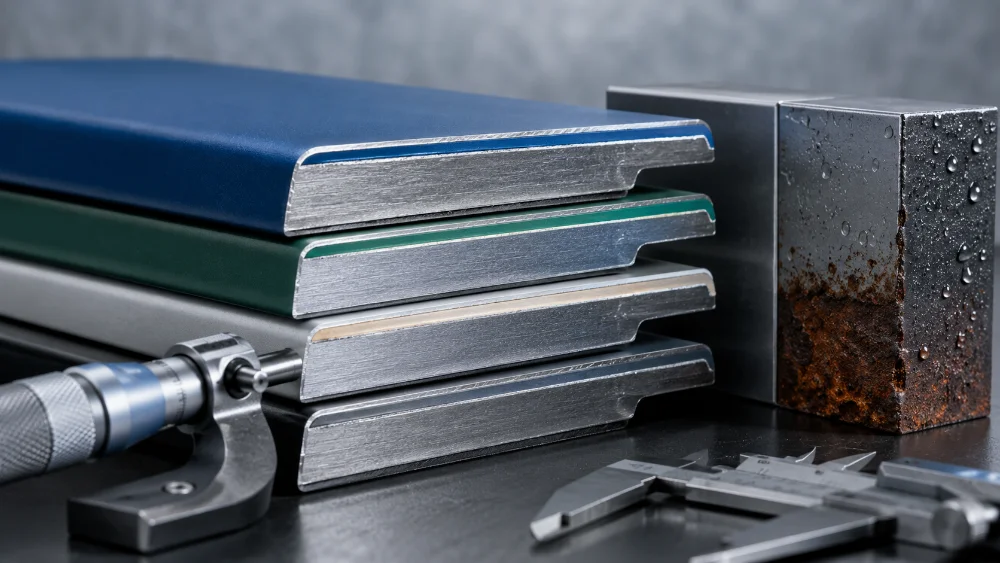
When buyers compare colored steel products, the first points they often examine are price, color, and nominal thickness.
However, long-term durability depends on a wider combination of technical factors. Two of the most important are steel thickness and coating quality.
These elements perform different roles. Steel thickness supports rigidity, strength, and resistance to mechanical damage. The coating system protects the surface from corrosion, weathering, fading, and chemical exposure.
At Ali Steel, we encourage customers to evaluate both factors together rather than choosing a product based on one specification alone.
Why Steel Requires Protection
Steel offers strength, versatility, and efficient fabrication, but it can corrode when exposed to oxygen and moisture.
Corrosion can accelerate in the presence of:
- Salt
- Humidity
- Industrial pollution
- Chemicals
- Condensation
- Fertilizers
- Animal waste
- Surface damage
To improve protection, steel is commonly coated with zinc or another zinc-based alloy.
The metallic coating creates a physical barrier between the steel and the environment. Zinc can also provide sacrificial protection around small scratches or exposed areas.
Prepainted steel adds several further layers, which may include:
- Steel substrate
- Metallic coating
- Chemical pretreatment
- Primer
- Topcoat
- Back coat
- Optional protective film
Each layer contributes to the final performance.
Metallic Coating Quality
The metallic coating is the primary corrosion-protection layer beneath the paint.
Its effectiveness depends on:
- Coating composition
- Coating mass
- Uniformity
- Surface condition
- Adhesion
- Environmental suitability
Galvanized steel uses a zinc coating. Other products may use aluminum-zinc or zinc-aluminum-magnesium systems.
These products do not perform identically, so buyers should compare actual technical specifications instead of relying only on general product names.
A dry interior application may require a different coating from exterior roofing in a coastal environment.
This is why Ali Steel reviews the intended application and exposure conditions when helping customers choose a suitable product.
Pretreatment and Primer
Some of the most important protective layers are not visible in the finished product.
Pretreatment prepares the metallic surface and improves the bond between the substrate and the paint.
Poor pretreatment can cause:
- Peeling
- Blistering
- Poor adhesion
- Under-film corrosion
- Reduced coating life
The primer forms an important connection between the treated steel and the topcoat. It may also contain corrosion-inhibiting components.
A premium topcoat cannot reliably compensate for weak surface preparation or inadequate primer.
Topcoat Chemistry
The topcoat provides the visible color, gloss, texture, and much of the weather resistance.
Common paint systems include:
- Standard polyester
- Silicone-modified polyester
- Polyurethane
- Plastisol
- PVDF or fluoropolymer
- Specialized industrial coatings
Different coating systems offer different levels of:
- Ultraviolet resistance
- Color retention
- Gloss retention
- Flexibility
- Scratch resistance
- Chemical resistance
- Forming performance
- Weather resistance
Standard polyester may be suitable for general construction, while improved coating systems may be selected for demanding climates, architectural projects, or aggressive environments.
Paint Thickness and Application Quality
Paint thickness is important, but it should never be evaluated alone.
A thick coating that is poorly cured or badly applied may perform worse than a correctly formulated coating of suitable thickness.
Coating performance depends on:
- Paint chemistry
- Surface preparation
- Primer compatibility
- Application uniformity
- Oven temperature
- Curing time
- Line speed
- Process control
The coating should also be flexible enough to withstand roll forming, bending, and profiling without cracking.
What Steel Thickness Controls
The steel substrate provides the mechanical foundation of the product.
Greater thickness may improve:
- Rigidity
- Resistance to denting
- Load capacity
- Fastener holding
- Handling resistance
- Span capability
- Dimensional stability
For roofing and cladding, thickness must be considered together with the profile.
A deeper profile may provide more rigidity than a shallow profile made from the same thickness.
Using material that is thinner than the project specification may lead to:
- Visible waviness
- Oil canning
- Excessive noise
- Vibration
- Installation damage
- Deformation
- Reduced wind resistance
Nominal and Actual Thickness
Buyers should understand how thickness is stated.
The quoted value may refer to:
- Base metal thickness
- Total coated thickness
- Nominal thickness
- Minimum thickness
- Average thickness
These values are not always identical.
A small difference may be commercially significant across a large order. More importantly, supplying material below the structural requirement may affect safety and performance.
At Ali Steel, clear product specifications help customers verify what thickness is being supplied and how it has been measured.
Thickness Cannot Replace Coating Quality
A thick steel sheet can still corrode if its protective coating is inadequate.
Similarly, a sheet with a high-quality coating may resist corrosion but fail to provide the required rigidity if the steel is too thin.
Durability is therefore the result of a complete system.
For example:
- Interior panels may prioritize appearance and cleanability.
- Industrial roofs may require both structural strength and strong corrosion protection.
- Sandwich-panel skins require coating consistency and good adhesion.
- Coastal buildings may need enhanced coating protection even when structural loads are moderate.
- Agricultural buildings may require protection on both the outer and inner surfaces.
The Importance of Environmental Exposure
The same steel product may perform very differently in two locations.
Factors that affect durability include:
- Distance from the sea
- Humidity
- Condensation
- Rainfall
- Industrial emissions
- Agricultural chemicals
- High temperatures
- Strong sunlight
- Dust
- Cleaning products
- Poor ventilation
The reverse side of roofing and cladding should also be considered. Internal humidity, condensation, or chemicals can damage the underside even when the exterior remains visually attractive.
How to Verify Product Quality
Before purchasing, ask for:
- Steel grade
- Base metal thickness
- Thickness tolerance
- Metallic coating type
- Coating mass
- Paint system
- Primer thickness
- Topcoat thickness
- Back-coat details
- Color code
- Gloss level
- Applicable standard
- Test certificates
- Warranty conditions
- Recommended environment
Quality testing may include:
- Coating thickness
- Adhesion
- Hardness
- Bend performance
- Impact resistance
- Color consistency
- Gloss measurement
- Corrosion testing
- Mechanical-property testing
Conclusion
Steel thickness and coating quality affect product durability in different but equally important ways.
Thickness determines the product’s mechanical strength, rigidity, and resistance to deformation. The coating system protects the steel from corrosion, sunlight, moisture, and environmental damage.
A reliable purchasing decision should evaluate both factors together.
At Ali Steel, we help customers select coated steel products based on the complete specification, including substrate thickness, metallic coating, paint system, application, and environment. This approach helps reduce premature failure and supports better long-term value.


