


- By ali-steel
- 28 Feb 2025
- Data Trading
- No Comments
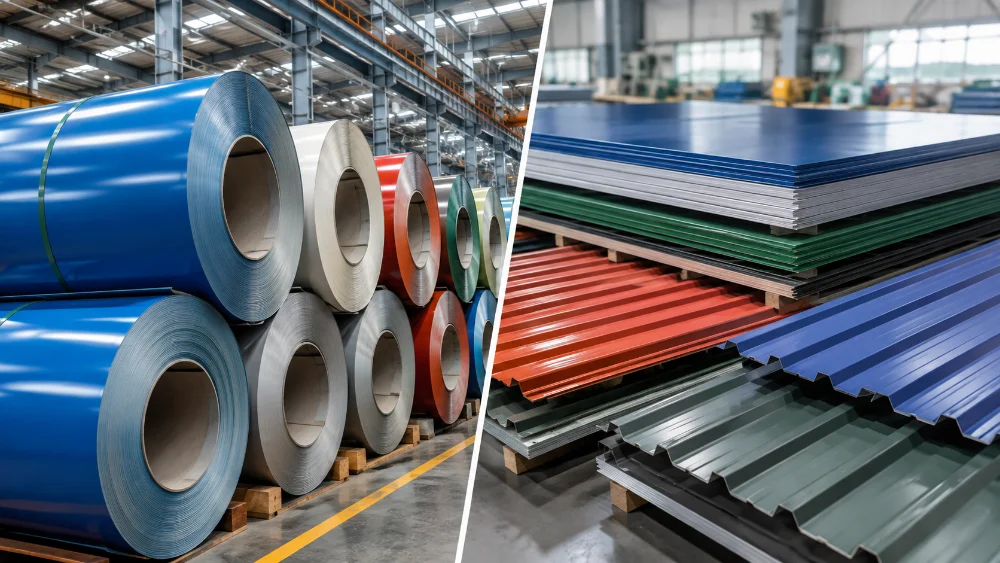
Colored steel sheets and colored steel coils are widely used across construction, manufacturing, roofing, appliance production, and industrial fabrication.
Although the two terms are sometimes treated as completely different products, they often refer to the same coated steel supplied in different forms. Colored steel coils are delivered as continuous rolls, while colored steel sheets are cut into individual lengths or formed panels.
Understanding the difference helps buyers select the most efficient option according to their equipment, order volume, storage capacity, and final application.
At Ali Steel, we supply and support steel products for different customer requirements, from manufacturers that need continuous coils to contractors that require ready-to-install sheets.
What Are Colored Steel Coils?
A colored steel coil is a long, continuous strip of prepainted steel wound into a roll.
The steel is usually coated with zinc or another protective metallic layer before being cleaned, pretreated, primed, painted, cured, cooled, and rewound.
Colored steel coils are commonly purchased by:
- Roll-forming companies
- Roofing-sheet manufacturers
- Sandwich-panel producers
- Appliance manufacturers
- Door and shutter factories
- Metal fabrication companies
- HVAC manufacturers
- Steel service centers
These businesses process the coils into finished products using specialized machinery.
Possible operations include:
- Slitting
- Cutting
- Roll forming
- Profiling
- Bending
- Stamping
- Laminating
- Pressing
Coils offer flexibility because the buyer can manufacture different sheet lengths, profiles, or components according to customer orders.
What Are Colored Steel Sheets?
Colored steel sheets are individual pieces cut from a coated steel coil.
They may be supplied as:
- Flat sheets
- Corrugated sheets
- Trapezoidal roofing sheets
- Tile-effect sheets
- Wall-cladding panels
- Custom-cut lengths
Colored steel sheets are often preferred by:
- Construction contractors
- Roofing installers
- Small workshops
- Maintenance companies
- Project owners
- Retail buyers
- Businesses without coil-processing equipment
The supplier performs the cutting or profiling before delivery, allowing the customer to use the sheets with minimal additional processing.
The Main Difference Is the Supply Form
The most obvious difference is the physical format.
A steel coil contains a continuous length of material. A steel sheet is a separate piece with fixed dimensions.
This difference affects:
- Processing requirements
- Order quantities
- Transportation
- Storage
- Handling
- Production flexibility
- Waste
- Final cost
A roofing manufacturer may prefer coils because it can produce panels in different lengths. A contractor working on one warehouse may prefer profiled sheets manufactured to the required roof dimensions.
Processing Equipment
Colored steel coils require specialized equipment.
Depending on the final product, the buyer may need:
- Decoilers
- Leveling machines
- Slitting lines
- Cut-to-length lines
- Roll-forming machines
- Pressing equipment
- Bending machines
- Protective-film systems
The company must also invest in trained operators, maintenance, quality control, power, and storage.
Colored sheets are simpler to use. They are often delivered ready for installation or require only basic site adjustments.
This makes sheets practical for customers who do not want to invest in processing machinery.
Production Flexibility
Coils provide greater flexibility for high-volume manufacturers.
A roll-forming company can use the same coil to produce sheets in several lengths, reducing waste from unnecessary end cuts. Production can also be adjusted according to incoming orders.
Pre-cut sheets offer less flexibility because their dimensions have already been established. Recutting them may increase waste or damage the coating near the edges.
However, ready-cut sheets can save time and simplify project planning when final dimensions are known.
Ali Steel works with customers to identify whether coil supply or sheet supply offers the most practical solution for their operations.
Cost Differences
Colored steel coils may offer a lower material-processing cost for large-volume buyers, but they require equipment, labor, power, maintenance, and storage.
Colored sheets may have a higher price per tonne because the supplier has completed additional processes, including:
- Leveling
- Cutting
- Profiling
- Sorting
- Packaging
- Handling
Despite the higher unit price, sheets may reduce the buyer’s total investment and operating costs.
The most economical option depends on:
- Order volume
- Available machinery
- Production frequency
- Labor costs
- Required product variety
- Storage capacity
- Transportation
- Material waste
For continuous production, coils are often more efficient. For individual projects or smaller quantities, sheets may provide better total value.
Minimum Order Quantity
Steel coils are generally sold in larger units and may require a higher initial investment.
Sheets offer more flexibility for customers who need smaller quantities or specific panel lengths.
Distributors often purchase full coils and convert them into sheets for smaller buyers. This allows end users to receive the required quantity without purchasing an entire coil.
At Ali Steel, product availability and order requirements can be discussed according to project size and customer needs.
Handling and Storage
Coils are heavy and create concentrated loads. They require appropriate lifting equipment and safe handling procedures.
Incorrect handling may cause:
- Edge damage
- Coil deformation
- Surface scratches
- Telescoping
- Movement during transportation
Sheets are easier to divide into packages, but long panels must still be handled carefully. Dragging one sheet over another can scratch the paint, while lifting a long sheet incorrectly can cause bending.
Both sheets and coils should be stored in a dry, ventilated location. Trapped water or condensation between coated surfaces may cause staining or coating damage.
Quality Considerations
If sheets and coils come from the same production batch, the original coating quality may be identical.
However, additional processing can affect the final result.
Poor-quality conversion may cause:
- Scratches
- Uneven sheets
- Cracked paint
- Rough edges
- Incorrect dimensions
- Profile deformation
- Surface marks
For this reason, buyers should evaluate not only the original coil quality but also the converter’s machinery, handling procedures, and inspection standards.
Which Option Is Right for You?
Colored steel coils may be the better choice when:
- You have continuous processing equipment
- You require large volumes
- You manufacture different profiles
- You need flexible lengths
- You can safely handle and store coils
Colored steel sheets may be the better choice when:
- You need material ready for installation
- You require fixed dimensions
- Your order volume is limited
- You do not own processing equipment
- You want simpler handling
- You need faster project execution
Conclusion
Colored steel coils and colored steel sheets are often the same engineered material presented in different supply formats.
Coils offer flexibility and efficiency for manufacturers. Sheets provide convenience and faster use for contractors, installers, and smaller fabricators.
At Ali Steel, we help customers compare both options according to production capacity, order quantity, application, storage, and budget. By selecting the right supply format, businesses can reduce waste, simplify operations, and achieve better overall value.


